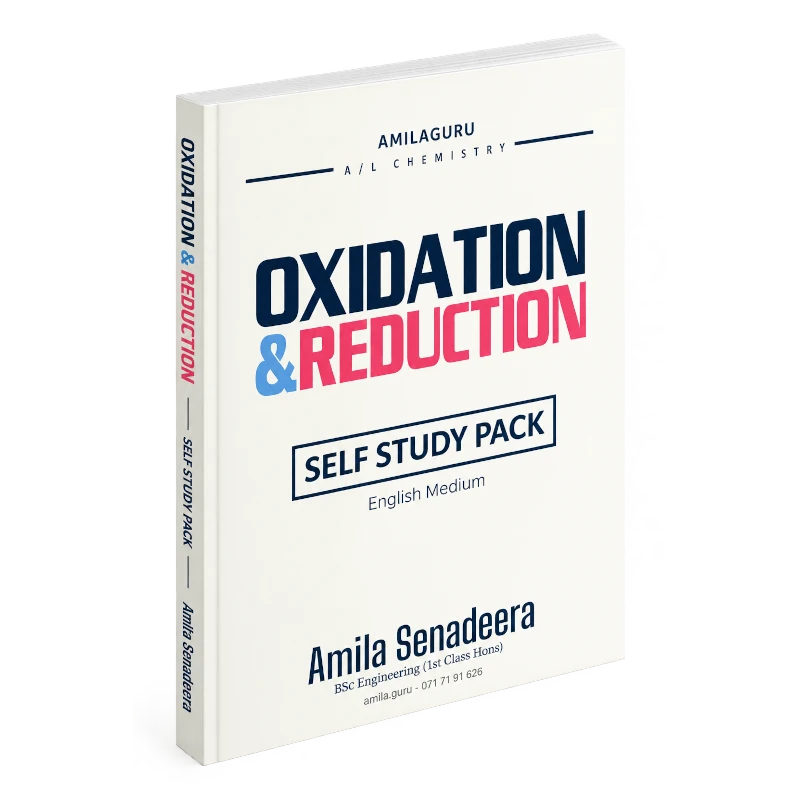
REDOX (Oxidation and Reduction) | A/L Chemistry | Self-Study Pack
රු3,450.00
A step-by-step self-study pack for the Oxidation and Reduction (REDOX) unit of G.C.E. (A/L) Chemistry: oxidation numbers, oxidation and reduction, balancing half-reactions and complete equations, oxidizing and reducing agents, hydrogen peroxide, and IUPAC naming of ions and compounds.
Every lesson has worked examples, Try It questions with full answers, and notes on the points where marks are most often lost. The pack also includes practice MCQs.
English medium.
✔ Islandwide Delivery
✔ Trusted by A/L Chemistry Students
✔ Secure Checkout
Description
Every time a battery powers a phone, a metal rusts, or a cell metabolizes glucose, electrons are moving. Redox questions ask you to track them: assign the oxidation numbers, say what is oxidized and what is reduced, and balance the equation so that mass and charge both add up. This pack teaches one method for each step, so a redox question becomes a procedure you have already practised, not something to guess at.
The idea that holds the unit together: The oxidation number is a bookkeeping value that makes electron transfer visible. Once you can assign it reliably, whether in a simple ion, in S₄O₆²⁻, or from a Lewis structure, the rest comes from the same ledger: what is oxidized, what is reduced, how many electrons move, and how the half-reactions balance.
Who it is for: Grade 12 and 13 students preparing for G.C.E. (A/L) Chemistry in English medium, whether you study alone, alongside a tutor or class, or use it for revision. It follows syllabus competencies 3.1, 3.2 and 3.3.
What is inside
Lesson 1: Rules for Assigning Oxidation Numbers
- The priority-ordered rules for assigning oxidation numbers.
- The exceptions examiners test: peroxides, superoxides, and metal hydrides.
Lesson 2: Finding Oxidation Numbers of Constituent Atoms
- Using algebra and the sum rule for neutral species and ions.
- Why some oxidation numbers are fractions, using S₄O₆²⁻.
Lesson 3: Finding Oxidation Numbers Using Electronegativity and Lewis Structures
- Assigning each bonding pair to the more electronegative atom.
- Why oxidation number is not the same as formal charge.
Lesson 4: Determining Maximum and Minimum Oxidation Numbers
- Predicting the highest and lowest oxidation numbers of main-group elements and the 3d series.
- The exceptions that catch students out, such as fluorine and the elements after manganese.
Lesson 5: The Concept of Oxidation and Reduction
- Defining oxidation and reduction by electron transfer and oxidation number change.
- Telling disproportionation from comproportionation.
Lesson 6: Algorithm for Balancing Half-Reactions
- A 6-step algorithm that starts from oxidation numbers, in acidic and basic media.
- Why you never need to guess how many water molecules to add.
Lesson 7: Balancing Complete Redox Equations
- Choosing the species that really exists in the equation (MnO₄⁻, not Mn⁷⁺).
- A 5-step method from half-reactions to the molecular or ionic equation.
Lesson 8: Identifying Oxidizing and Reducing Agents
- Using oxidation number changes to find what is oxidized, what is reduced, and the agent in each case.
- The go-to agents you are expected to recognize on sight.
Lesson 9: Hydrogen Peroxide (H₂O₂): The Double Agent of Redox
- Why H₂O₂ can be an oxidizing agent in one reaction and a reducing agent in another.
- Its half-reactions in acidic and basic media.
Lesson 10: Balancing Half-Reactions in Neutral Media
- Why H⁺ and OH⁻ cannot be reactants in a neutral solution.
- A medium-rules summary for acidic, basic, and neutral conditions.
Lesson 11: IUPAC Nomenclature of Ions and Compounds (Stock System)
- Naming cations, anions, and oxoanions with Roman numerals.
- Naming ionic compounds and writing their formulae.
Also included
- Practice 20 MCQs, so you can test yourself and find weak topics.
- A unit overview that sets out what the examiner tests most.
- A syllabus coverage table.
- A Quick-Review Checklist to track your progress.
- A companion notebook, free with your purchase.
- A visual concept map of the whole unit.
How each lesson works
- A Think About This hook to start the lesson and build intuition.
- Key Points that pull out the core rule or definition.
- Worked Examples that show the reasoning step by step.
- Common Traps: what students often get wrong, and why.
- Examiner’s Eye: what the mark scheme actually looks for.
- Try It questions with full model answers, so you can test yourself before you look at the solution.
After this pack you will be able to
- Assign the oxidation number of any atom in a molecule or ion, using the rules, algebra, or the Lewis structure.
- State the highest and lowest oxidation numbers an element can show.
- Decide whether a reaction is a disproportionation, a comproportionation, or neither.
- Balance a half-reaction in acidic, basic, or neutral medium without guessing.
- Combine half-reactions into a balanced equation for permanganate and dichromate reactions.
- Explain why hydrogen peroxide oxidizes in one reaction and reduces in another.
- Name ions and compounds with the Stock system and write formulae from the names.
Format and access
App access, delivered after purchase. Use the pack alongside the lessons and quizzes on the AMILAGuru app.
Android app 👉 Google Play Store
Windows app 👉 Download the App
Linux AppImage 👉 Download the AppImage
FAQs
What does the pack cover?
Oxidation numbers (rules, algebra, Lewis structures, and their limits), oxidation and reduction, disproportionation and comproportionation, balancing in acidic, basic, and neutral media, oxidizing and reducing agents, hydrogen peroxide, and IUPAC naming of ions and compounds.
Do I need another pack first?
No. It starts from ions and electrons. Non-redox calculations (moles, molarity, limiting reagents, mixture problems) are in the Chemical Calculations pack, so the two work well together.
Chemical Calculations | A/L Chemistry | Self-Study Pack 👉 Start Learning!
Does it replace my class?
Yes, for learning the concepts. The pack covers every concept in the unit step by step, with worked examples and Try It questions with answers, so you can learn the whole topic from it without attending a class.
Is there a companion notebook?
Yes. When you purchase this pack, the companion notebook is included free. It is where you write your own notes, work, and Try It answers as you go through the lessons.
How can I practise past paper questions?
Use the AMILAGuru Past Paper Discussion (PPD) pack for REDOX. It takes real A/L past paper questions and discusses them step by step, so you can see how each one is answered and where the marks are earned. Learn the concepts from this pack first, then move to the PPD to apply them. 👉 The PPD pack for REDOX is coming soon.