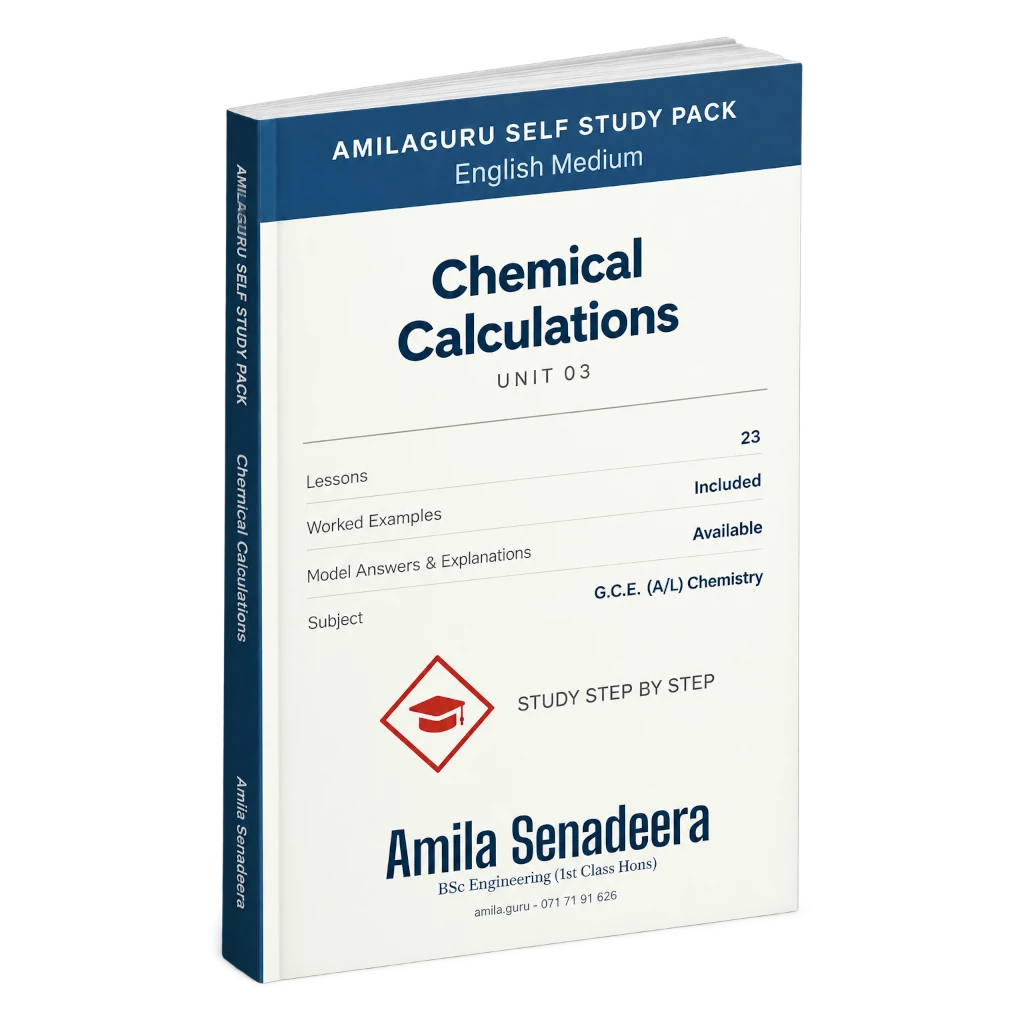
Chemical Calculations | A/L Chemistry | Unit 03 Self-Study Pack
රු5,950.00
A step-by-step self-study pack for the Chemical Calculations unit of G.C.E. (A/L) Chemistry: the mole, stoichiometry, concentrations, balancing equations, and mixture problems.
Every lesson has worked examples, common traps, examiner’s eye notes, and assignments with full answers.
The ultimate foundation pack for Unit 03. English medium.
✔ Islandwide Delivery
✔ Trusted by A/L Chemistry Students
✔ Secure Checkout
Description
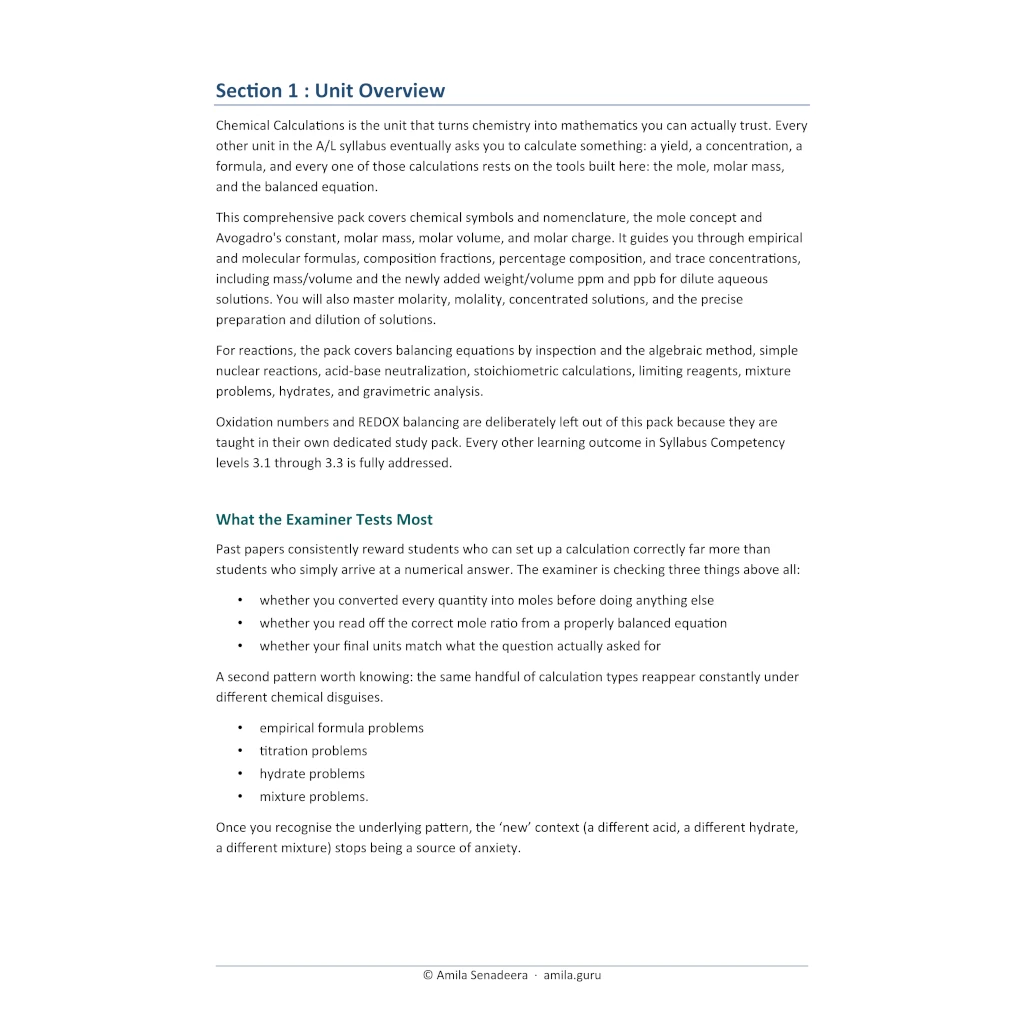
Chemical Calculations is the unit that turns chemistry into mathematics you can actually trust. Every other unit in the A/L syllabus eventually asks you to calculate something: a yield, a concentration, a formula. Every one of those calculations rests on the tools built here: the mole, molar mass, and the balanced equation.
The idea that holds the unit together: Almost everything here comes down to one bridge: the mole ratio from a balanced chemical equation. Once you master converting mass, volume, or concentration into moles, crossing that ratio bridge, and converting back, you can solve almost any quantitative problem the syllabus throws at you.
Who it is for: Grade 12 & 13 students preparing for G.C.E. (A/L) Chemistry in English medium, whether you study alone, alongside a tutor or class, or use it for revision. It follows the syllabus competencies 3.1, 3.2, and 3.3. (Note: Oxidation numbers and Redox balancing are deliberately taught in a separate, dedicated Redox pack).
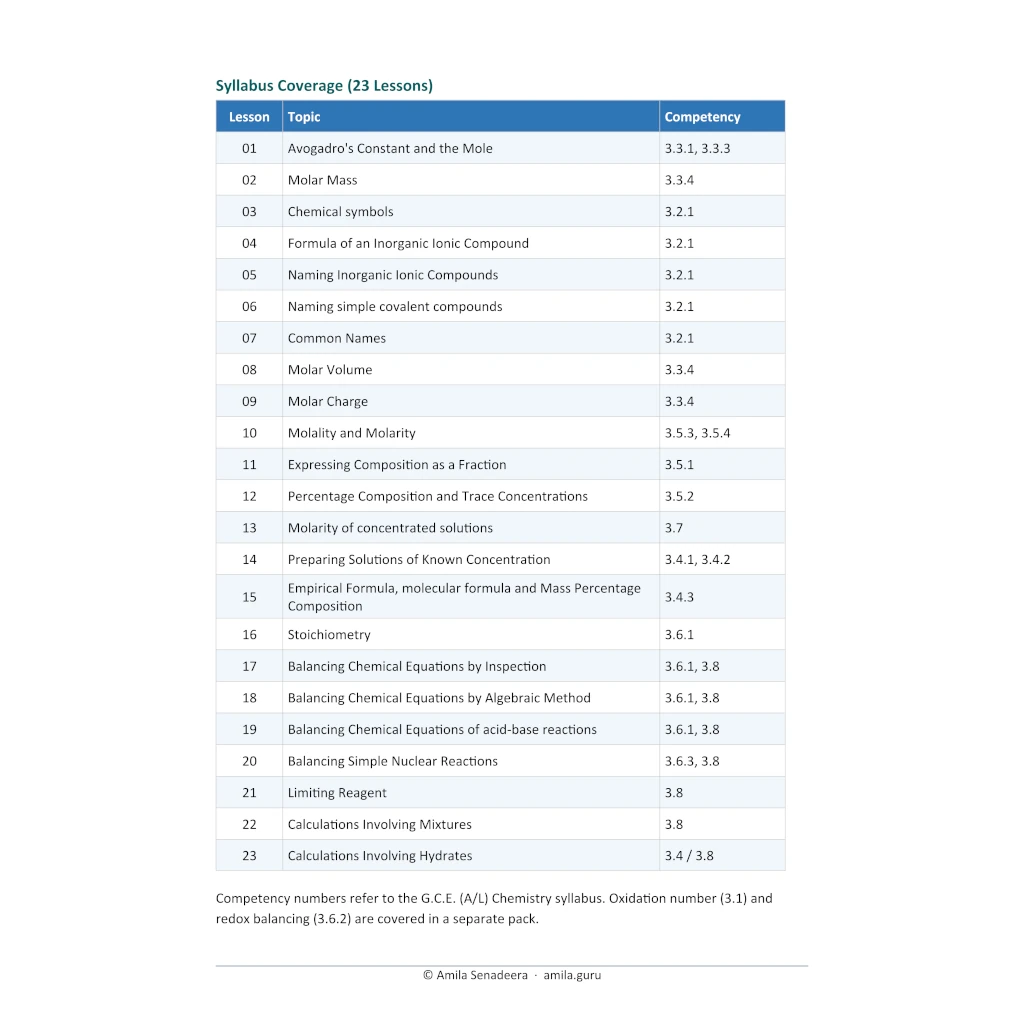
What is inside (23 Comprehensive Lessons)
Lessons 1-3: The Mole Foundation
- Avogadro’s constant and counting elementary entities (atoms, molecules, ions).
- Converting between mass, moles, and molar mass without unit errors.
- Chemical symbols, including Latin-derived names and essential valency tables.
Lessons 4-7: Chemical Nomenclature
- Writing formulas for inorganic ionic compounds by balancing charges to zero.
- Naming ionic compounds, including variable-charge metals (e.g., Cu⁺ vs Cu²⁺, Fe²⁺ vs Fe³⁺).
- Naming covalent compounds using Greek prefixes.
- Common (trivial) names you must memorize for the exam.
Lessons 8-9: Gases & Charge
- Gas calculations using molar volume at STP.
- Calculating total molar charge using Faraday’s constant and ionic charge numbers.
Lessons 10-14: Concentrations & Solutions
- Molarity, molality, and why they aren’t numerically identical.
- Expressing composition: mass/volume fractions, mole fractions, and percentages.
- Trace concentrations: ppm, ppb, and the crucial weight/volume (w/v) proofs (mg dm⁻³ and µg dm⁻³) for dilute aqueous solutions.
- Calculating the molarity of concentrated stock solutions directly from density and % purity.
- Preparing standard solutions and performing precise volumetric dilutions.
Lessons 15-17: Formulas & Balancing
- Determining empirical and molecular formulas from percentage composition.
- Stoichiometry and the mole-ratio bridge.
- Balancing equations by inspection and the algebraic method (for complex equations).
Lessons 18-20: Acid-Base & Nuclear Reactions
- Balancing complex acid-base neutralization reactions (including polyprotic acids).
- Balancing simple nuclear reactions (alpha/beta decay, fission, fusion) using conservation rules.
Lessons 21-23: Advanced Stoichiometry
- Identifying the limiting reagent using the “moles ÷ coefficient” golden rule.
- Solving complex mixture problems using algebraic flowcharts and gravimetric analysis principles.
- Calculating the water of crystallisation (x) in hydrated salts from thermal decomposition data.
Also included
- A companion notebook, free with your purchase.
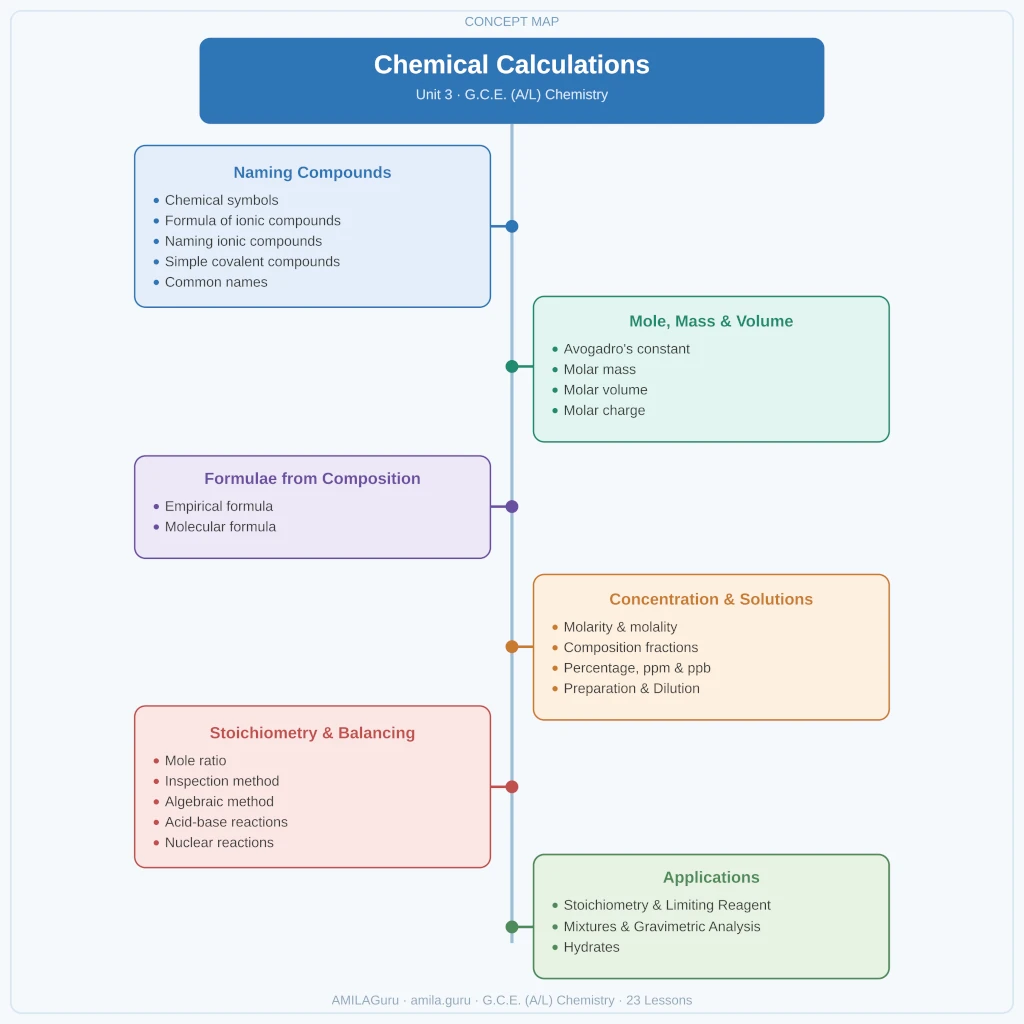
- A visual concept map of the whole unit.
- A complete Equation & Formula Reference Sheet.
- A punchy unit overview and syllabus coverage table.
- A Quick-Review Checklist to track your 23-lesson progress.
How each lesson works
- A Think About This hook to start the lesson and build intuition.
- Key Points that pull out the core rule, definition, or formula.
- Worked Examples that show the reasoning step by step, with mark allocations.
- Common Traps: what students often get wrong, and why.
- Examiner’s Eye: what the mark scheme actually looks for to award full marks.
- Assignments & Try It questions with full model answers to test your understanding before you look at the solution.
After this pack you will be able to
- Instantly find the limiting reagent in any two-reactant problem without guessing.
- Calculate the exact volume of concentrated acid needed to prepare a dilute standard solution using density and purity.
- Balance complex chemical equations using the algebraic method when inspection fails.
- Solve multi-step mixture and gravimetric analysis problems using algebraic flowcharts.
- Confidently convert between ppm, ppb, mg dm⁻³, and µg dm⁻³ for environmental water samples.
Format and access
App access, delivered after purchase.
Android app 👉 [Google Play Store]
Windows app 👉 [Download the App]
Linux AppImage 👉 [Download the AppImage]
Windows app 👉 [Download the App]
Linux AppImage 👉 [Download the AppImage]
FAQs
Does it cover the whole unit?
Yes, it covers all calculation-based outcomes for competencies 3.1, 3.2, and 3.3, including empirical formulas, concentrations, stoichiometry, and limiting reagents.
Yes, it covers all calculation-based outcomes for competencies 3.1, 3.2, and 3.3, including empirical formulas, concentrations, stoichiometry, and limiting reagents.
Where are Oxidation Numbers and Redox Balancing?
Because Redox is such a massive and heavily tested topic, it is taught in its own dedicated companion pack: Oxidation & Reduction (Redox) | A/L Chemistry Self-Study Pack. This keeps the Chemical Calculations pack focused and prevents it from becoming overwhelmingly large.
Because Redox is such a massive and heavily tested topic, it is taught in its own dedicated companion pack: Oxidation & Reduction (Redox) | A/L Chemistry Self-Study Pack. This keeps the Chemical Calculations pack focused and prevents it from becoming overwhelmingly large.
Does it replace my class?
Yes, for learning the concepts. The pack covers every concept in the unit step by step, with worked examples and assignments with full answers, so you can learn the whole topic from it without attending a class.
Yes, for learning the concepts. The pack covers every concept in the unit step by step, with worked examples and assignments with full answers, so you can learn the whole topic from it without attending a class.
Is there a companion notebook?
Yes. When you purchase this pack, the companion notebook is included free. It is where you write your own notes, equation summaries, and assignment answers as you work through the 23 lessons.
Yes. When you purchase this pack, the companion notebook is included free. It is where you write your own notes, equation summaries, and assignment answers as you work through the 23 lessons.
How can I practice Past Paper Questions?
Use the AMILAGuru Past Paper Discussion (PPD) packs. They take real A/L past paper questions and discuss them step by step, so you can see how each one is answered and where the marks are earned. Learn the concepts from this pack first, then move to the PPD to apply them.
Use the AMILAGuru Past Paper Discussion (PPD) packs. They take real A/L past paper questions and discuss them step by step, so you can see how each one is answered and where the marks are earned. Learn the concepts from this pack first, then move to the PPD to apply them.



Reviews
There are no reviews yet.