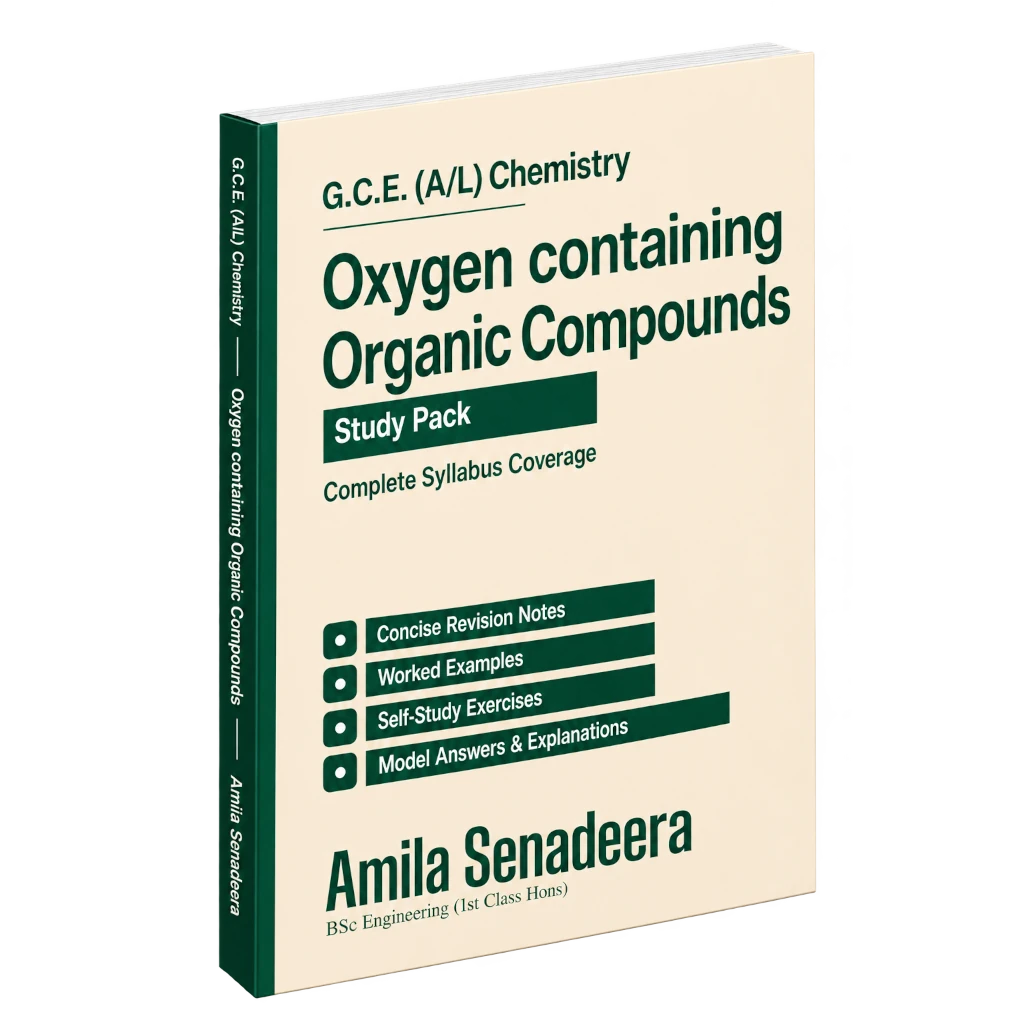
Oxygen Containing Organic Compounds | A/L Chemistry | Organic Chemistry Self-Study Pack – 3
රු2,450.00
A step-by-step self-study pack for the Oxygen-Containing Organic Compounds unit of G.C.E. (A/L) Chemistry: alcohols, phenols, aldehydes and ketones, carboxylic acids, and acid derivatives.
Every lesson has worked examples, common traps, examiner’s eye notes, and Try It questions with answers.
Volume 3 of the Organic Chemistry Quartet. English medium.
✔ Islandwide Delivery
✔ Trusted by A/L Chemistry Students
✔ Secure Checkout
Description
Oxygen-containing compounds are where A/L organic chemistry becomes detective work. An unknown liquid forms an orange precipitate with 2,4-DNP, gives no silver mirror with Tollens’ reagent, and is reduced by NaBH₄ to a secondary alcohol. Name it, and explain every result. This pack teaches each reaction with its exact reagents, conditions and observations, so every one of those clues is something you have already practised.
The idea that holds the unit together: Almost everything here comes down to two questions: how polarised is the key bond, and once a nucleophile or a proton has acted, is there a leaving group? Bond polarity and resonance explain why acidity rises from alcohols to phenols to carboxylic acids. The leaving-group question explains why aldehydes and ketones undergo addition while acid chlorides, esters and amides undergo substitution. You learn each argument once and use it many times.
Who it is for: Grade 12 & 13 students preparing for G.C.E. (A/L) Chemistry in English medium, whether you study alone, alongside a tutor or class, or use it for revision. It follows the syllabus competencies 9.1 to 9.6.
What is inside
Lesson 1: Alcohols – Structure and Physical Properties
- Classifying alcohols as primary, secondary and tertiary, and monohydric, dihydric and trihydric alcohols.
- How hydrogen bonding explains boiling points, branching effects, and the fall in water solubility down the series.
Lesson 2: Reactions of Alcohols
- Reactions that break the O–H bond (sodium, esterification) and the C–O bond (HBr, HI, PCl₃, PBr₃, PCl₅).
- The Lucas test, explained through carbocation stability.
- Dehydration to alkenes, and oxidation of primary, secondary and tertiary alcohols, including why PCC stops at the aldehyde.
Lesson 3: Reactions of Phenol
- Why phenol is more acidic than an alcohol, explained through resonance of the phenoxide ion.
- Reactions with sodium and sodium hydroxide, and why neither phenol nor an alcohol reacts with NaHCO₃.
- Why phenols do not undergo nucleophilic substitution at the C–O bond.
Lesson 4: Reactivity of the Benzene Ring in Phenols
- Why the –OH group makes the ring more reactive than benzene and directs substitution to the ortho and para positions.
- Bromine water (2,4,6-tribromophenol) and nitration with dilute nitric acid, compared with benzene’s conditions.
Lesson 5: Aldehydes and Ketones
- The structure and polarity of the carbonyl group, and why its characteristic reactions are nucleophilic additions.
- Addition of HCN and Grignard reagents with mechanisms, and the rule for which class of alcohol you get.
- 2,4-DNP as a test for the carbonyl group: addition followed by dehydration.
Lesson 6: Self-condensation of Aldehydes and Ketones
- Why α-hydrogens are acidic and how a base generates the nucleophilic carbanion.
- Self-condensation of ethanal and propanone with aqueous NaOH, and dehydration of the product.
Lesson 7: Reduction and Oxidation of Aldehydes and Ketones
- Reduction with NaBH₄ and LiAlH₄, and Clemmensen reduction of C=O to CH₂.
- Oxidation with Tollens’ reagent, Fehling’s solution, and acidified KMnO₄ or K₂Cr₂O₇.
- Telling an aldehyde from a ketone, with the exact observation to record.
Lesson 8: Carboxylic Acids
- Dimeric hydrogen bonding and its effect on boiling points and solubility.
- The acidity order alcohols < phenols < carboxylic acids, explained through the stability of the conjugate base.
- Reactions with Na, NaOH and Na₂CO₃/NaHCO₃, PCl₃/PCl₅, alcohols, and LiAlH₄.
Lesson 9: Reactions of Carboxylic Acid Derivatives
- Why acid derivatives undergo substitution while aldehydes and ketones undergo addition.
- Acid chlorides with water, NaOH, alcohols, phenol, ammonia and primary amines, including the full mechanism with the tetrahedral intermediate.
- Reactions of esters and amides with acids, NaOH, Grignard reagents and LiAlH₄.
Also included
- A companion notebook, free with your purchase.
- A visual concept map of the whole unit.
- A punchy unit overview and syllabus coverage table.
- Quick-reference reaction summaries.
- A Quick-Review Checklist to track your progress.
How each lesson works
- A Think About This hook to start the lesson and build intuition.
- Key Points that pull out the core rule or definition.
- Worked Examples that show the reasoning step by step, with mark allocations.
- Common Traps: what students often get wrong, and why.
- Examiner’s Eye: what the mark scheme actually looks for.
- Try It questions with model answers to test your understanding before you look at the solution. Questions that ask you to draw structures are answered as videos.
After this pack you will be able to
- Tell primary, secondary and tertiary alcohols apart with the Lucas test and explain the order using carbocation stability.
- Explain, using resonance, why acidity increases from alcohols to phenols to carboxylic acids.
- Tell an aldehyde from a ketone with Tollens’ reagent or Fehling’s solution and state exactly what you observe.
- Predict the alcohol formed when a Grignard reagent reacts with methanal, another aldehyde, or a ketone.
- Explain why acid chlorides, esters and amides undergo substitution while aldehydes and ketones undergo addition.
Format and access
App access, delivered after purchase.
Android app 👉 Google Play Store
Windows app 👉 Download the App
Linux AppImage 👉 Download the AppImage
FAQs
Does it cover the whole unit?
Yes, all six competencies, 9.1 to 9.6: alcohols, phenols, aldehydes and ketones, carboxylic acids, and acid derivatives.
Do I need the earlier volumes?
This pack builds on benzene’s electrophilic substitution (for phenol) and on the nucleophile and carbocation ideas from earlier organic topics, so it works best after those. You can also use it on its own for revision. Volume 4 (Nitrogen Containing Organic Compounds) builds on the acid chloride and amide chemistry in this pack.
Basic Concepts of Organic Chemistry | Organic Chemistry Self-Study Pack – 1 👉 Start Learning!
Hydrocarbons and Halohydrocarbons | Organic Chemistry Self-Study Pack – 2 👉 Start Learning!
Oxygen-Containing Organic Compounds | Organic Chemistry Self-Study Pack – 3 👉 Start Learning!
Nitrogen-Containing Organic Compounds | Organic Chemistry Self-Study Pack – 4 👉 Start Learning!
Does it replace my class?
Yes, for learning the concepts. The pack covers every concept in the unit step by step, with worked examples and Try It questions with answers, so you can learn the whole topic from it without attending a class.
How are the drawing questions answered?
Try It questions that ask you to draw structures, such as the isomers of C₄H₁₀O, have their answers as videos in the app, where you can watch the structures drawn.
Is there a companion notebook?
Yes. When you purchase this pack, the companion notebook is included free. It is where you write your own notes, reaction summaries, and Try It answers as you work through the lessons. You receive it free after purchasing the study pack.
How can I practice Past Paper Questions?
Use the AMILAGuru Past Paper Discussion (PPD) pack for Organic Chemistry. It takes real A/L past paper questions and discusses them step by step, so you can see how each one is answered and where the marks are earned. Learn the concepts from this pack first, then move to the PPD to apply them.
How can I practice more?
Use the AMILAGuru Organic Chemistry Workbook. It has 50 questions with detailed answer keys, so you can keep practising after you finish the pack.
Organic Chemistry Workbook + 50 Comprehensive Questions, Model Answers & Explanations 👉 Grab your Copy



Reviews
There are no reviews yet.